

Contents
Introduction
If you've ever ordered a coffee topped with a perfect cloud of cream, or watched a chef finish a dessert with a fluffy swirl in two seconds, you've seen a whipped cream charger at work. They're small, simple, and most people who use them never learn what's actually inside—or how to tell a good one from a bad one.
This guide covers what a whipped cream charger is, how it works, what it's used for, the sizes available, and the details that actually matter when you're choosing one. It's written for both home cooks and professionals, because the same principles apply whether you're making one dessert or running a café.
What Is a Whipped Cream Charger?
A whipped cream charger is a small steel cylinder filled with food-grade nitrous oxide (N₂O) under pressure. It's used together with a whipped cream dispenser (also called a whipper or cream siphon) to instantly turn liquid cream into stable, fluffy whipped cream—no manual whisking, no electric mixer.
The standard charger is single-use, made entirely of recyclable steel, and contains 8 grams of N₂O. It's about 6.3 cm long and 1.8 cm wide, with a foil-sealed tip at one end. When you screw it into a dispenser, an internal pin pierces that foil, releasing the gas into the cream chamber.
You'll see a few terms used interchangeably in listings, and knowing them helps you buy the right thing the first time:
-
Whipped cream charger / N₂O charger: the cartridge itself (most commonly 8g).
-
Whipped cream dispenser cartridges: a generic way sellers describe the same N₂O chargers.
-
Nitrous oxide (N₂O): the propellant gas that dissolves into cream and creates a stable texture.
In a home kitchen, the charger is usually an 8g cartridge paired with a 0.5L dispenser. In a busy café, the "charger" people talk about may be a larger cylinder paired with a regulator for continuous service. The science is the same—only the volume changes.
What Gas Is Used, and Why Nitrous Oxide?
Cream chargers use food-grade nitrous oxide (N₂O), a gas commonly used in culinary applications. It plays a key role in both the texture and consistency of whipped products.
Three properties of N₂O make this work:
It dissolves into fat, not water. This is why cream needs at least 30% fat content (heavy cream or whipping cream)—there has to be enough fat for the gas to bind to. Skim milk won't whip.
It's neutral and tasteless. Unlike CO₂, which produces a sour, metallic taste in cream because it forms carbonic acid, N₂O leaves the flavor untouched.
It's bacteriostatic. N₂O inhibits bacterial growth, which is why a charged dispenser can sit in the fridge for up to two weeks without spoiling.
That aeration is different from formulation-based whipped cream stabilization, where ingredients such as gelatin, mascarpone, or starch are used when a preparation needs additional structural support.
From a safety and compliance perspective, food-grade gases must meet strict standards. Organizations such as the U.S. Food and Drug Administration (FDA) and the European Food Safety Authority (EFSA) regulate their use in food preparation across the United States and Europe.
One important distinction: food-grade N₂O is not the same as industrial or automotive N₂O. Industrial grades can contain additives and are unsafe for cream. Always confirm your supplier sells food-grade gas produced under certified food-contact standards.
How Cream Chargers Work (The Science)
The cream whipper relies on gas expansion. When you whip cream by hand or with a mixer, you beat fine air bubbles into the cream, creating a foam—a matrix that traps air. A gas-charged whipper achieves the same result in a completely different way.
When the foil seal is pierced, pressurized N₂O rushes into the dispenser and dissolves into the cream. Because of the pressure, the absorbed gas can be thought of as extremely small bubbles within the cream. At this stage, the mixture is essentially still liquid cream—the bubbles are simply too small to see.
Chilled liquids absorb gases more easily at high pressure, which is why it's best to use cold cream and keep the whole unit in the refrigerator. A limited amount of shaking exposes more cream to the gas and improves absorption—but don't overdo it. Excessive shaking can degrade the texture of the finished cream, so a few firm shakes are usually enough.
When you release the cream from the device, the absorbed gas expands rapidly. The bubbles grow larger, and the cream-to-bubble ratio shifts toward the light foam we know as whipped cream. It's really the same process as hand-whipping—only with nitrous oxide inside the bubbles instead of plain air.
This is also the same principle behind carbonated beer and soda: the beverage absorbs CO₂ as pressure increases in a sealed container, and when you open the vessel, the gas expands into larger bubbles that rise and form a foamy head.
Charger Sizes: 8g vs. Larger Cylinders
The size you need comes down to one thing: how much cream you go through in a day.
The 8g standard charger
The 8-gram charger is the global standard for home and light commercial use. One charger pairs with a 0.5L dispenser and produces about 1.5L of whipped cream—enough for around 10 servings.
Larger cylinders for volume
For higher-volume operations, large cylinders are the standard. The cost per gram drops sharply, and the operator no longer wastes time changing chargers every batch.
| Size | Equivalent 8g chargers | Best for |
|---|---|---|
| 8g cartridge | 1 | Home kitchens, small cafés |
| 320g cylinder | ~40 | Small dessert shops, coffee chains |
| 640g cylinder | ~80 | Restaurants, bars |
| 2000g cylinder | ~250 | Bakeries, foodservice chains |
| 3000g cylinder | ~375 | Industrial co-manufacturing |
Important safety note: large cylinders require a pressure regulator. Internal cylinder pressure can be very high (commonly cited around 200 bar), while a dispenser is typically rated for only 10–12 bar. Direct connection will damage the dispenser. The regulator steps the pressure down to a safe working range.

How Many Chargers Do You Need?
For most standard dispensers, the answer is straightforward: a 0.5L dispenser typically uses 1 charger per fill. The real variables are your recipe (fat content, sugar, stabilizers) and how stiff you want the final foam to be.
| Dispenser size | Typical chargers per fill | Notes |
|---|---|---|
| 0.25L | 1 (often works with less, but start with 1) | Small bottles can feel over-pressurized if you overfill |
| 0.5L | 1 | The most common setup for home use |
| 1.0L | 1–2 | Some recipes need a second charger for stiffness; follow dispenser guidance |
Always check the manufacturer's manual, and never over-pressurize the canister.
Step-by-Step: Using a Whipped Cream Charger
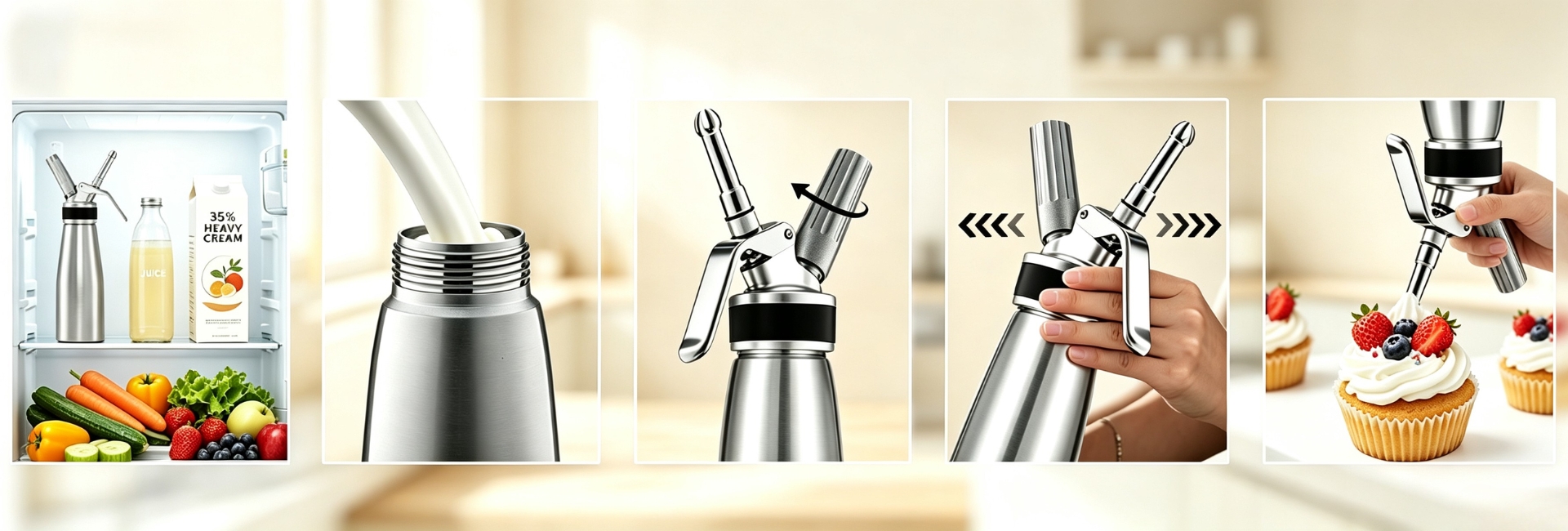
1. Chill everything. Cold cream holds gas better and whips more consistently. Chill the dispenser too.
2. Fill the dispenser. Pour cold heavy cream into a compatible dispenser, leaving space at the top for the gas to expand the cream. If you're adding flavorings like vanilla or sugar, mix them with the cream before filling. Fill to the max line—overfilling reduces headspace and makes charging inconsistent.
3. Load the charger. Place the charger into the charger holder and screw it onto the dispenser. Once securely fastened, the N₂O gas is released into the dispenser. You should hear a slight hissing sound.
4. Shake hard. A firm shake helps dissolve the N₂O into the liquid instead of leaving it in the headspace. Just a few firm shakes are needed—stop once the gas is evenly distributed.
5. Dispense. Hold the dispenser upside down and press the lever gently. The pressure pushes the whipped cream out in a smooth, airy consistency. Control the pressure and speed to achieve your desired texture.
6. Clean and maintain. After use, unscrew the head, remove any remaining cream, and rinse all parts with warm soapy water. Clean the nozzle thoroughly to avoid clogs. Inspect the seals—worn gaskets and cross-threaded heads create leaks and pressure issues. Keep spare gaskets on hand if you use your dispenser regularly.
Tips and Tricks for Perfect Whipped Cream
Choosing the right cream
The fat content of your cream is crucial. For best results, use cream with a fat content of at least 30%—heavy whipping cream (36%+ fat) is ideal for a thick, luxurious texture.
Flavor enhancements
One of the joys of using cream chargers is the ability to experiment. Infuse your whipped cream with vanilla extract, chocolate syrup, or fruit purées for a unique twist. Simply add your chosen flavoring to the cream before charging it.
Troubleshooting common issues
-
Runny cream: usually happens when the cream is too warm. Ensure both the cream and the dispenser are chilled before use.
-
Over-whipped cream: if your whipped cream comes out too stiff, you've likely over-shaken the dispenser. A few firm shakes are enough—stop as soon as the gas is evenly distributed.
Storage tips
If you're not using all of your whipped cream at once, store it in the dispenser in the fridge. Because the dispenser is airtight and the N₂O inhibits bacterial growth, freshly charged cream can stay fresh for up to 10–14 days. Give the dispenser a gentle shake before each use to refresh the texture.
Safety and Responsible Use
Whipped cream chargers are safe when used as directed with a proper dispenser. Apexgas strongly emphasizes responsible use:
-
Use only with a whipped cream dispenser. Never puncture a charger directly.
-
Never inhale the gas. Direct inhalation of nitrous oxide is dangerous and can cause oxygen deprivation, frostbite, loss of consciousness, or death. The FDA has warned that N₂O products are intended for culinary use only, and misuse is dangerous and illegal in many jurisdictions.
-
Non-flammable does not mean risk-free. N₂O can support combustion—it can make other materials burn more readily—and chargers are pressurized metal containers. Keep them away from flammables.
-
Do not heat or modify chargers. Store below 50°C (122°F), away from direct sunlight, ovens, and burners. Never leave chargers in a hot car.
-
Never refill a charger. All modern chargers are non-refillable, single-use products. The steel was not designed for repeated pressurization, and the foil seal is destroyed on first use. Attempting to refill is dangerous.
-
Inspect your equipment. Worn gaskets and cross-threaded heads create leaks and pressure issues.
-
Keep out of reach of children. Treat chargers as you would any pressurized container.
-
Store and dispose properly. Keep chargers in a cool, dry place in their original box or a closed container so they don't roll around and get dented. Empty chargers are made of steel and can be recycled where facilities exis

Creative Uses Beyond Whipped Cream
While whipped cream is the primary application, professionals use chargers for much more:
| Application | What it's used for |
|---|---|
| Whipped cream | Standard sweet cream for desserts, coffee, and pastries |
| Espumas & savory foams | Light foams of stock, vegetable purée, or cheese for fine dining |
| Mousses | Quick chocolate, fruit, or savory mousses without gelatin |
| Rapid infusions | Infusing oils, syrups, or spirits in about 90 seconds instead of overnight |
| Cocktail foams | Stable foam toppings for cocktails and mixology |
| Fluffy batters | Carbonating waffle or pancake batters for a lighter result |
This is why bartenders, pastry chefs, and fine-dining kitchens use cream chargers as standard equipment—not just for dessert prep, but as a fast, repeatable way to add texture and flavor across the menu.

How to Choose Reliable Cream Chargers
This is the part most articles skip. Not all cream chargers are equal, even though they look identical from the outside. Here's what actually matters.
Gas purity
Food-grade N₂O is the baseline industry standard, commonly 99.5% or 99.9% purity, with premium grades reaching 99.95%. The remaining fraction is where the difference shows up—moisture, oil residue, or contaminants from the gas filling process. Low-purity chargers can leave a metallic aftertaste in the cream or shorten the dispenser's gasket life. If a supplier can't tell you the exact purity number, that's a red flag.
Steel quality and wall thickness
The cylinder walls need to handle high pressure at full charge, and even higher in summer storage conditions. Quality chargers use cold-rolled steel with consistent wall thickness—around 2mm is standard. Cheaper chargers cut corners on steel grade or thickness, which can cause bulging in hot storage or, in worst cases, rupture during use.
Foil seal and filling consistency
Each 8g charger should contain exactly 8.0g of N₂O—not 7.5g, not 7.8g. Variation comes from filling-line calibration and quality control. A batch where some chargers under-fill means inconsistent whipped cream from the same recipe. The foil seal at the tip needs to puncture cleanly when the dispenser pin hits it; a poorly sealed foil leaks gas before the dispenser is fully charged.
Certifications
For commercial use, look for production under FDA, CE, FSSC22000, or SGS certified standards. These aren't decorative logos—they verify food-contact safety, gas filling protocols, and traceability. For OEM and B2B import, certification is also what gets the product through customs in the EU and North America.
Vertically integrated manufacturing
The global cream charger industry is concentrated in a small number of specialty gas factories. Buying gas from one supplier and cylinders from another introduces inconsistency between batches. Single-roof factories control purity, fill weight, and material quality across the entire process—which is why most professional B2B brands source from this kind of supplier.
Why Businesses Rely on Cream Chargers
In busy kitchens and high-demand service environments, consistency isn't optional—it's expected. Yet many businesses still struggle with uneven results, slow preparation, or unreliable supply. Cream chargers solve those bottlenecks by simplifying preparation and making output predictable.
Used across cafés, restaurants, bars, catering services, and distribution networks, chargers deliver faster, more consistent results at scale. The operational advantages include:
-
Reduced preparation time
-
Minimized batch-to-batch variation
-
Improved workflow efficiency
-
Better portion control
For multi-location businesses, standardized processes help maintain consistent output across every site. For high-volume distributors, reliable performance ensures end users can depend on the product every time.
One practical note: if you buy bulk packs for a café or catering workflow, pair them with a dispenser that's easy to clean and keep spare gaskets on hand. Bulk savings disappear fast if you waste chargers from leaks or cross-threaded heads.
Where to Buy: Bulk, Wholesale, and Choosing a Supplier
For businesses, sourcing cream chargers is not just about finding a supplier—it's about finding one that can meet demand consistently. Whether you're searching for cream chargers wholesale or bulk cream chargers, look beyond price and evaluate:
-
Product consistency across batches
-
Reliable stock availability
-
Fast, predictable delivery timelines
-
Compliance with food-grade standards (FDA, EFSA)
-
B2B-focused communication and support
Bulk purchasing lets businesses reduce long-term costs, avoid frequent restocking, and plan operations more efficiently. Working with a reliable supplier means planning confidently, maintaining consistent output, and focusing on growth rather than supply issues.
Questions worth asking any supplier:
-
What is the exact N₂O purity?
-
What is the guaranteed fill weight per charger?
-
What certifications cover the production facility?
-
Can you provide batch traceability?
If a supplier can't answer these clearly, treat it as a warning sign.
Why Choose ApexGas?
At ApexGas, we supply food-grade nitrous oxide chargers manufactured to consistent purity and fill-weight standards. Whether you're outfitting a home kitchen, a coffee shop, or a restaurant, our chargers are designed to deliver reliable performance batch after batch.
We focus on the details that matter: verified fill weight, quality filtration for a clean taste, certified food-grade production, and reliable supply across both 8g chargers and larger formats for commercial volume. Browse our selection and stock up with confidence—or get in touch to discuss supply options for your business.
Conclusion
A whipped cream charger is a steel cylinder of food-grade N₂O that, paired with a dispenser, turns liquid cream into stable whipped cream in seconds. The principle is simple physics—pressurized gas dissolves into fat, then expands into bubbles when the pressure drops. But the quality of what you get out of the dispenser depends entirely on what's inside the charger: gas purity, fill weight, steel quality, and the manufacturing standards behind them.
For home cooks, a reliable 8g charger from a reputable brand is all you need. For cafés, restaurants, and chains running real volume, large cylinders with a pressure regulator are the right setup. And for distributors and brand owners building a product line, the supplier you pick is the difference between a clean business and constant quality complaints.
Ready to start creating? Explore ApexGas's range of cream chargers or get in touch to discuss supply options.
Frequently Asked Questions
What is a cream charger?
A cream charger is a small steel cylinder filled with food-grade nitrous oxide (N₂O) under pressure. It's used together with a whipped cream dispenser to instantly turn liquid cream into stable, fluffy whipped cream—no manual whisking required. The standard size is 8g and is single-use, but larger cylinders from 320g up to 3000g are also available for commercial volume.
What gas is inside a cream charger?
Cream chargers contain food-grade nitrous oxide (N₂O). Food-grade N₂O is produced under strict purity standards (commonly 99.5% to 99.95%) and filled in facilities certified for food contact. Industrial or automotive N₂O can contain additives and is unsafe for cream.
How does a cream charger work?
When you screw a charger into a dispenser, an internal pin pierces the foil seal at the tip. The pressurized N₂O rushes into the dispenser and dissolves into the cream. When you press the lever, the cream is forced out through the nozzle, and the sudden pressure drop causes the dissolved gas to expand into thousands of tiny bubbles—creating the light, airy whipped texture.
Are cream chargers food safe?
Yes, when used as intended. Food-grade cream chargers are produced under standards such as FDA, CE, FSSC22000, or SGS specifically for kitchen use. They're labeled for culinary purposes only. Inhalation is unsafe and illegal in many jurisdictions.
Can you reuse a cream charger?
No. All modern cream chargers are non-refillable, single-use products. Once the foil seal is pierced and the gas is released, the seal is permanently destroyed. The steel shell is fully recyclable through standard metal recycling. Attempting to refill a used charger is dangerous.
What's the difference between cream chargers and CO₂ chargers?
Different gases for different uses. CO₂ is for soda water and carbonated beverages—it dissolves in water and creates a fizzy, slightly acidic taste. N₂O is for cream—it dissolves in fat and is neutral in flavor. Using CO₂ in cream produces a sour, metallic taste because CO₂ forms carbonic acid. Always match the gas to the application: N₂O for whipping cream, CO₂ for carbonation.
How long does whipped cream from a charger last?
Up to two weeks if the charged dispenser is sealed and stored in the fridge. This is significantly longer than hand-whipped cream because the N₂O inhibits bacterial growth and the sealed, pressurized environment limits oxidation. Give the dispenser a few gentle shakes before each use to redistribute the gas.
Do whipped cream chargers expire?
Chargers don't have a strict food-style expiration date, but they can become unreliable if stored poorly or the seal is compromised. Store them cool and dry, and discard any charger that looks rusty, dented, or damaged. Properly stored, sealed chargers can last for years.
How many 8g chargers do you need for a 1-liter dispenser?
Many 1-liter dispensers work with 1–2 chargers per fill, depending on the dispenser's instructions and the recipe. A common approach is to start with one charger, shake thoroughly, and test the dispense. If the foam is too loose and your dispenser manual allows it, a second charger can increase stiffness and stability. Always follow the manufacturer's guidance.
Are cream chargers flammable?
Most cream chargers are labeled non-flammable, but that does not mean risk-free. Nitrous oxide can support combustion—it can make other materials burn more readily—and chargers are pressurized metal containers. Store them away from heat sources, direct sun, and flammable materials.
Where can I buy cream chargers?
They can be purchased from reputable food-grade suppliers offering bulk and reliable supplies. For business buyers, look for consistent stock availability, batch traceability, food-grade certification, and B2B support. Apexgas supplies both home and commercial customers.
Safety note: Nitrous oxide should only be used as directed for culinary purposes. Misuse of N₂O products is dangerous and illegal in many jurisdictions. Keep chargers out of reach of children and store them as pressurized containers.